


Kolb's Experiential Learning Cycle in Nursing: 4 Stages, Worked Reflective Essay & Guide (2026)
Kolb's Experiential Learning Cycle in Nursing: 4 Stages, Worked Reflective Essay & Guide (2026)
Direct Answer & Quick Summary: What is Kolb's Experiential Learning Cycle in Nursing?
Kolb's Experiential Learning Cycle, formulated by educational theorist David A. Kolb (1984), is a foundational 4-stage pedagogical and reflective model asserting that "learning is the process whereby knowledge is created through the transformation of experience." Widely embedded in nursing and healthcare curricula across the United Kingdom, United States, Canada, and Australia, Kolb's model bridges the crucial gap between academic classroom theory and high-stakes bedside clinical reality. The learning cycle operates across four sequential, continuous stages: 1. Concrete Experience (CE) (the active clinical encounter), 2. Reflective Observation (RO) (stepping back to objectively examine what transpired), 3. Abstract Conceptualisation (AC) (analyzing the encounter using physiological, pharmacological, and evidence-based clinical guidelines), and 4. Active Experimentation (AE) (testing newly formulated clinical behaviors in subsequent bedside practice). Additionally, Kolb's framework correlates these stages into four distinct clinical learning styles—Diverging, Assimilating, Converging, and Accommodating. Academic mentors at AssignPro Solutions guide university nursing scholars in transforming clinical encounters into distinction-grade reflective essays, OSCE debriefs, and professional revalidation portfolios.

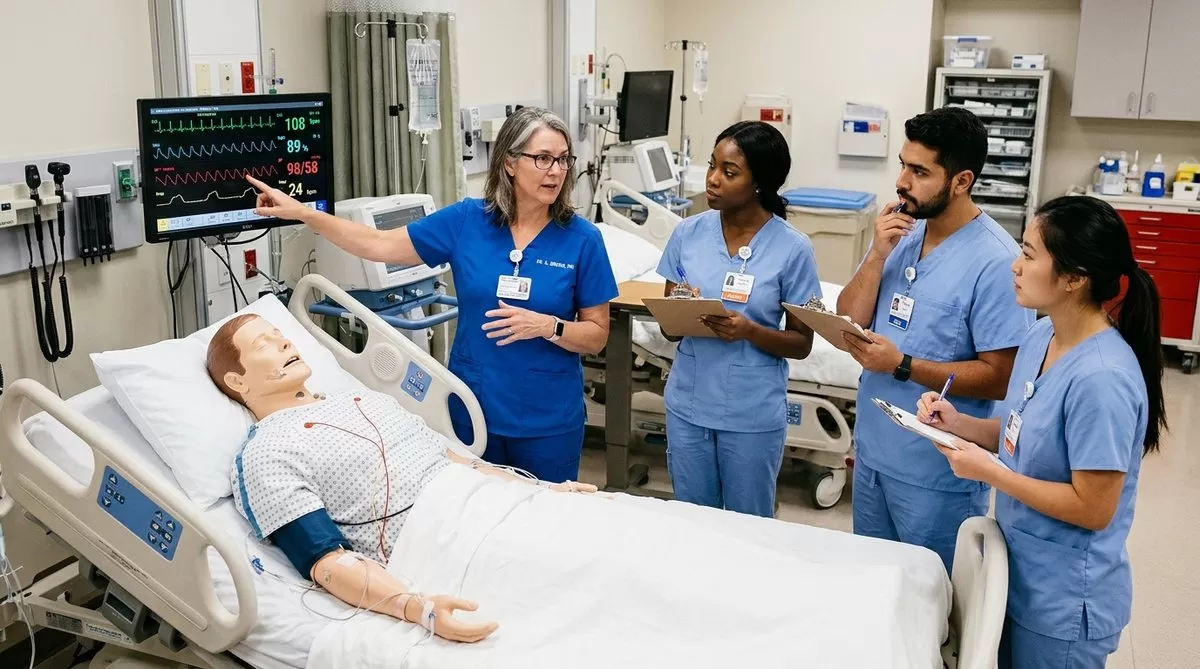
Figure 1: Clinical nursing educator facilitating an experiential learning debrief with undergraduate healthcare students following an emergency simulation scenario.
Table of Contents
- 1. Theoretical Foundations of David Kolb's Experiential Learning Theory (1984)
- 2. The 4 Essential Stages of Kolb's Learning Cycle Explained
- 3. Kolb's 4 Learning Styles in Clinical Healthcare Education
- 4. Comparative Analysis: Kolb vs. Gibbs vs. Schon vs. Driscoll
- 5. Comprehensive Worked Reflective Essay: Acute Ventricular Tachycardia (VT) Resuscitation
- 6. University Academic Marking Rubric: First-Class (Distinction 85%+) vs. Failing Criteria
- 7. Common Student Traps in Kolb Reflective Writing and How to Avoid Them
- 8. Frequently Asked Questions (FAQs)
1. Theoretical Foundations of David Kolb's Experiential Learning Theory (1984)
In modern clinical healthcare education, memorizing pharmacology textbooks and anatomical diagrams is insufficient for cultivating distinction-grade clinical reasoning. Real bedside competence requires what Donald Schön termed "reflection-in-action" and "reflection-on-action". In 1984, educational philosopher David A. Kolb published his groundbreaking text "Experiential Learning: Experience as the Source of Learning and Development", heavily synthesizing the seminal intellectual traditions of John Dewey (philosophical pragmatism), Kurt Lewin (social psychology and action research), and Jean Piaget (cognitive-developmental psychology).
Kolb argued that human cognition is not a passive repository for static information; rather, ideas are continually formed and reformed through active engagement with reality. In nursing practice, experiential learning explains how a novice nursing student who experiences acute panic during their first medical emergency (e.g., severe anaphylaxis or sudden desaturation) transforms that raw emotional vulnerability into calm, automatic clinical mastery through structured reflection, theoretical rationalization, and repeated simulation testing.
2. The 4 Essential Stages of Kolb's Learning Cycle Explained
Kolb portrays learning as an integrated spiral where each stage feeds directly into the next. To achieve genuine transformative learning, the practitioner must travel through all four stages:
Stage 1: Concrete Experience (CE)
The "Doing / Feeling" Stage: The practitioner is directly immersed in a tangible clinical scenario. It is the immediate, phenomenological event—administering an unfamiliar medication, communicating bad news to an anxious relative, or participating in a rapid response call.
Core Prompt: What was the exact clinical encounter, my tangible role, and my raw emotional and sensory experience?
Stage 2: Reflective Observation (RO)
The "Watching / Reflecting" Stage: Stepping back from direct clinical action to review the event from multiple perspectives. The clinician examines discrepancies between theoretical expectations and actual bedside execution, acknowledging emotional reactions and non-verbal cues.
Core Prompt: What went well? Where did communication falter? What did the patient and multidisciplinary team observe?
Stage 3: Abstract Conceptualisation (AC)
The "Thinking / Generalizing" Stage: The intellectual engine of the cycle. The clinician synthesizes observations with peer-reviewed literature, physiological pathophysiology, pharmacological principles, and clinical practice guidelines (NICE, Resuscitation Council, WHO).
Core Prompt: Why did the physiology respond as it did? What does evidence-based clinical literature dictate should occur in this scenario?
Stage 4: Active Experimentation (AE)
The "Planning / Trying" Stage: Translating theoretical concepts into actionable, modified clinical behaviors. The nurse plans how to execute skills differently, completes targeted simulation training, and tests new communication techniques in subsequent patient encounters.
Core Prompt: How will I modify my clinical protocol and communication the next time a comparable emergency presents?
3. Kolb's 4 Learning Styles in Clinical Healthcare Education
Kolb identified that individuals prioritize different stages of the learning cycle along two dual axes: Grasping Experience (Concrete Experience vs. Abstract Conceptualisation) and Transforming Experience (Reflective Observation vs. Active Experimentation). This yields four distinct clinical learning profiles:
| Learning Style | Combined Preferred Stages | Clinical Nursing Strengths | Potential Educational Pitfalls |
|---|---|---|---|
| 1. Diverger | Concrete Experience (CE) + Reflective Observation (RO) | Highly empathetic, culturally sensitive, exceptional at holistic psychosocial assessment and viewing patient issues from multiple angles. | Can experience decision paralysis in fast-moving clinical resuscitations where immediate decisive action is demanded. |
| 2. Assimilator | Abstract Conceptualisation (AC) + Reflective Observation (RO) | Mastery of pathophysiology, pharmacology, laboratory data interpretation, and constructing complex evidence-based care plans. | May struggle with interpersonal bedside warmth; risks prioritizing physiological numbers over patient emotional dignity. |
| 3. Converger | Abstract Conceptualisation (AC) + Active Experimentation (AE) | Decisive problem-solver, thrives in high-pressure technical environments (ICU, Emergency Department, Operating Theatre), excels at algorithms (ACLS). | May jump to premature clinical conclusions before exploring subtler biopsychosocial or ethical complexities. |
| 4. Accommodator | Concrete Experience (CE) + Active Experimentation (AE) | Hands-on, highly adaptable clinician who learns through direct trial and error; highly proactive during ward crises. | May act impulsively without verifying hospital clinical policies or reviewing the patient's baseline pharmacological chart. |
4. Comparative Analysis: Kolb vs. Gibbs vs. Schon vs. Driscoll
A frequent inquiry from students at AssignPro Solutions is: "How does Kolb's model differ from Gibbs' Reflective Cycle?" While Gibbs (1988) explicitly centers on personal emotional processing (Stage 2: Feelings), Kolb (1984) is fundamentally a cognitive and experiential learning architecture. Kolb's Stage 3 (Abstract Conceptualisation) places heavier emphasis on synthesizing formal theoretical models and evidence-based science than Gibbs' broader "Analysis" stage.
5. Comprehensive Worked Reflective Essay: Acute Ventricular Tachycardia (VT) Resuscitation
Examine the following distinction-grade reflective account formatted according to Kolb's four experiential stages:
Worked Essay: Managing a Periarrest Cardiac Arrhythmia (Word Count: ~1,100 words)
Stage 1: Concrete Experience (CE)
During my final-year coronary care placement, I was caring for Mr. Edward, a 62-year-old male admitted with an acute anterior ST-elevation myocardial infarction (STEMI) managed via primary percutaneous coronary intervention (PCI). At 14:15, while I was preparing his scheduled subcutaneous low-molecular-weight heparin, the continuous central cardiac telemetry monitor emitted an urgent audible arrhythmia alarm. Glancing at the screen, I noted a wide-complex, monomorphic tachycardia at a rate of 190 beats per minute. Entering Mr. Edward's room, I found him conscious but pale, diaphoretic, and reporting sudden severe dizziness and chest tightness. My sensory and emotional response was visceral: my pulse raced, and I experienced an acute surge of adrenaline. I immediately depressed the emergency bedside nurse call bell, checked his central carotid pulse (which was rapid but palpable), and attached high-flow oxygen via a non-rebreather mask while calling for the emergency defibrillator. The crash team arrived within two minutes, confirmed pulseless transition into sustained Ventricular Tachycardia (VT), delivered a synchronized DC cardioversion shock at 150 Joules, and restored sinus rhythm.
Stage 2: Reflective Observation (RO)
Reflecting retrospectively upon the resuscitation, I recognized several key observations. Positively, my cognitive recognition of the lethal dysrhythmia on telemetry was immediate, and activating the emergency call bell ensured rapid multidisciplinary team presence. However, during the 90 seconds prior to the crash team's arrival, my actions suffered from situational tunnel vision. Due to cognitive overload, I neglected to record a rapid manual blood pressure, which would have formally classified Mr. Edward as having "adverse features" (shock, syncope, myocardial ischemia, or heart failure) under Resuscitation Council UK guidelines. Furthermore, when the medical registrar asked for the patient's most recent serum potassium and magnesium levels, I had not retrieved the morning biochemistry report from the electronic health record, causing a 3-minute delay in identifying severe hypokalemia (K+ 3.1 mmol/L) as the primary arrhythmogenic trigger.
Stage 3: Abstract Conceptualisation (AC)
To analyze this critical event theoretically, I synthesized clinical literature surrounding post-infarction electrophysiology and crisis resource management. Under the Resuscitation Council UK (2021/2025) Advanced Life Support (ALS) Tachycardia Algorithm, ventricular tachycardia with a pulse must be immediately triaged for life-threatening adverse features. If adverse features are present (as demonstrated by Mr. Edward's diaphoresis, dizziness, and hypotension), up to three synchronized shocks are the first-line intervention, followed by IV amiodarone 300 mg over 10-20 minutes. Pathophysiologically, acute ischemia disrupts the myocardial membrane potential, predisposing the ventricle to re-entrant electrical circuits that are dramatically exacerbated by electrolyte derangements, particularly hypokalemia and hypomagnesemia (Katzung, 2021). From an educational theory perspective, my response mirrored Kolb's (1984) Accommodator style—jumping into immediate hands-on action (attaching oxygen, calling for the defibrillator) while omitting the analytical baseline data gathering (biochemistry verification, formal adverse feature scoring) characteristic of an Assimilator.
Stage 4: Active Experimentation (AE)
To close the experiential loop and transform this critical event into hardened clinical mastery, I formulated an actionable development plan:
1. I completed advanced scenario-based simulation training using the ALS Megacode protocol, specifically practicing structured verbal handovers using the ISBAR format under high-stress cardiac arrest conditions.
2. I established a systematic clinical routine for my cardiac ward practice: every morning prior to patient medication rounds, I systematically audit electrolyte profiles (potassium, magnesium, calcium) for all post-PCI patients, proactively escalating borderline hypokalemia (K+ < 4.0 mmol/L) for oral or IV replacement.
3. During a subsequent placement shift when another patient exhibited new-onset atrial fibrillation with rapid ventricular response (HR 160 bpm), I immediately performed a structured adverse feature assessment, obtained vital signs, and presented the electrolyte panel to the medical registrar within 90 seconds, leading to prompt, calm intravenous beta-blocker titration.
6. University Academic Marking Rubric: First-Class (Distinction 85%+) vs. Failing Criteria
| Assessment Criterion | Distinction Grade Standard (80–100%) | Failing / Borderline Standard (<50%) |
|---|---|---|
| Application of 4 Stages | Masterfully navigates all 4 stages. Demonstrates seamless transition from experiential narrative (CE) to deep theoretical analysis (AC) and concrete behavioral modification (AE). | Neglects Stage 3 (AC) entirely; treats the essay as a descriptive diary without scientific or evidence-based grounding. |
| Critical Evidence Synthesis | Rigorously integrates national clinical guidelines (Resuscitation Council, NICE, AHA), pathophysiology, and pharmacological mechanisms. | Contains zero academic citations; relies on personal opinions or unverified websites. |
| Reflective Depth & Vulnerability | Demonstrates exceptional emotional maturity and honest self-critique; articulates learning style strengths and cognitive blind spots. | Superficial description; avoids examining mistakes or blames other staff members defensively. |
| Active Experimentation (AE) | Details specific, measurable clinical actions taken or planned, linking learning to professional registration standards (NMC/ANA/NMBA). | Vague platitudes such as "Next time I will be more confident and read more guidelines." |
7. Common Student Traps in Kolb Reflective Writing and How to Avoid Them
Pitfall Alert: Neglecting Stage 3 (Abstract Conceptualisation)
University markers frequently note that nursing students write vivid descriptions of what happened (CE) and their feelings (RO), but fail to engage in Abstract Conceptualisation (AC). Stage 3 is where you prove your academic rigor! You must answer: What physiological laws, pharmacological dynamics, psychological theories, or clinical protocols explain why this event occurred?
8. Frequently Asked Questions (FAQs)
Q1: Must I always start at Stage 1 (Concrete Experience) in Kolb's cycle?
While nursing essays typically begin with Stage 1 (an authentic clinical encounter), Kolb emphasized that learning can theoretically begin at any point in the cycle (for instance, reading a new research paper in Abstract Conceptualisation and then testing it in Active Experimentation). However, for university reflective assignments, starting with a concrete bedside incident is the standard convention.
Q2: What is the ideal word count distribution across Kolb's 4 stages?
For a 1,500-word essay:
• Stage 1 (Concrete Experience): ~250 words (15-20%)
• Stage 2 (Reflective Observation): ~350 words (20-25%)
• Stage 3 (Abstract Conceptualisation): ~500 words (35-40%)
• Stage 4 (Active Experimentation): ~300 words (20%)
• Introduction & Conclusion: ~100 words
Q3: How does AssignPro Solutions assist healthcare scholars with Kolb reflective essays?
Our team of senior clinical nurse educators and academic consultants at AssignPro Solutions provides expert essay deconstruction, guideline alignment (NMC, Resuscitation Council, NICE, AACN), Turnitin originality verification, and distinction-grade structural editing tailored to university assessment standards globally.