


Driscoll Model of Reflection: What, So What, Now What? Worked Nursing Case Studies & Student Guide (2026)
Driscoll Model of Reflection: What, So What, Now What? Worked Nursing Case Studies & Student Guide (2026)
Direct Answer & Quick Summary: What Is the Driscoll Model of Reflection?
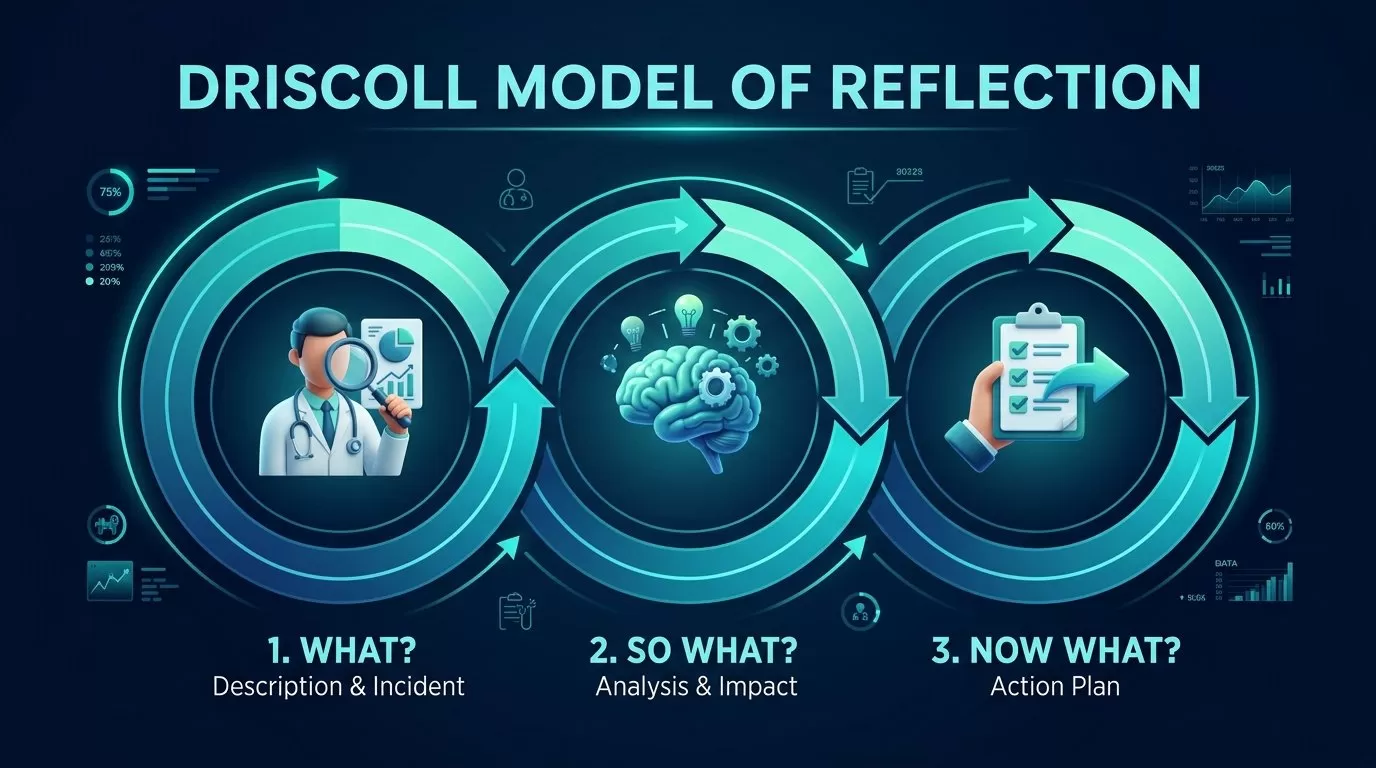
The Driscoll Model of Reflection (1994, 2000, 2007) is a structured, 3-stage experiential learning framework utilized extensively across nursing, healthcare education, and professional clinical revalidation. Adapted by healthcare educator John Driscoll from Dr. Terry Borton's seminal 1970 curriculum questions, the model organizes complex clinical incidents around three progressive inquiry stems: 1. WHAT? (describing the factual clinical event, context, and immediate actions), 2. SO WHAT? (critically analyzing emotional responses, clinical evidence, ethical codes, and consequences), and 3. NOW WHAT? (formulating a concrete, transformative action plan for future professional practice). In contrast to more segmented frameworks like the 6-stage Gibbs Reflective Cycle, Driscoll's streamlined architecture prevents students from getting trapped in repetitive descriptive storytelling, ensuring greater focus on critical evaluation and evidence-based practice. Academic mentors at AssignPro Solutions guide nursing scholars through clinical reflection mastery, portfolio revalidation, and distinction-grade university rubrics.
Every clinical shift presents registered nurses and student clinicians with defining moments: a medication administration near-miss during a chaotic ward handover, an ethical dilemma regarding patient consent in acute palliative care, or an unexpected physiological deterioration requiring an emergency SBAR communication escalation. While real-time bedside interventions stabilize the patient and contemporaneous charting is recorded in SOAPIE progress notes, true professional competence develops through structured post-incident debriefing and critical reflection.
Yet, when university nursing students sit down to write their reflective coursework or clinical portfolio submissions, a familiar crisis unfolds: students spend 80% of their word count narrating the chronological details of what happened, leaving almost zero space for critical evaluation, pathophysiological reasoning, or ethical analysis. University markers across the United Kingdom (NMC), Australia (NMBA), Canada (CNO), and the United States (AACN) routinely penalize descriptive storytelling, awarding passing marks only to essays that demonstrate deep critical analysis and evidence-based synthesis.
The Driscoll Model of Reflection was created to solve this academic and professional dilemma. By reducing reflective inquiry to three profound, inescapable questions, Driscoll forces the clinician to rapidly transition from retrospective storytelling into rigorous critical analysis and transformative action planning. This comprehensive 2026 student guide covers the theoretical epistemology of Driscoll's framework, stage-by-stage prompt matrices, the 70/30 critical analysis rule, a comparative model matrix (Driscoll vs. Gibbs vs. Johns vs. Schön), two fully worked distinction-grade clinical essays, and the university grading criteria required to score 85%+ First-Class honors.
Table of Contents
- 1. Theoretical Origins: From Terry Borton (1970) to John Driscoll (1994, 2000, 2007)
- 2. Why Driscoll Works: Simplicity as a Catalyst for Deep Critical Thinking
- 3. Anatomy of the 3 Stages: Granular Prompt Questions Matrix
- 4. The Golden 70/30 Critical Reflection Rule for Distinction Nursing Essays
- 5. Comparative Reflective Architecture: Driscoll vs. Gibbs vs. Johns vs. Schön
- 6. 2 Real Clinical Case Studies & Distinction-Grade Worked Driscoll Reflections
- 7. Integrating Evidence-Based Guidelines, Pharmacology & The NMC Code into Driscoll
- 8. Top 7 Costly Mistakes Nursing Students Make in Driscoll Reflections (And Fixes)
- 9. University Marking Rubrics: What Separates a 50% Pass from an 85% Distinction
- 10. Professional Reflective Essay Mentorship by AssignPro Solutions
- 11. Frequently Asked Questions (FAQ)
- 12. Student Pre-Submission Driscoll Reflection Audit Checklist
1. Theoretical Origins: From Terry Borton (1970) to John Driscoll (1994, 2000, 2007)
To cite Driscoll correctly in academic writing, nursing students must understand the historical lineage of the model. Many students erroneously cite Driscoll as the sole inventor of the three questions; in academic marking rubrics, failing to acknowledge the model's roots in Terry Borton's educational philosophy results in deductions for poor theoretical scholarship.
In 1970, American educator Terry Borton published his landmark book Reach, Touch, and Teach: Student Concerns and Process Education. Borton argued that meaningful human learning occurs not through passive rote memorization, but through an experiential cycle guided by three simple questions:
- What? – Sensing the external world, observing facts, and identifying personal feelings.
- So What? – Transforming observations into meaning, understanding implications, and integrating theory.
- Now What? – Deciding how to act based on that newly acquired understanding.
Twenty-four years later, British healthcare consultant and nurse educator John Driscoll recognized the extraordinary clinical value of Borton's stem questions. In 1994, Driscoll adapted Borton's trio into a dedicated healthcare reflective framework, published in the seminal paper "Reflective practice for practise" (Senior Nurse, 1994). Driscoll subsequently refined the framework in two major editions:
- Driscoll (2000): Practising Clinical Supervision: A Reflective Approach for Healthcare Professionals – introduced dedicated trigger prompt matrices tailored to clinical mentorship, preceptor relationships, and post-shift debriefing.
- Driscoll (2007): Practising Clinical Supervision: A Reflective Approach (2nd Edition) – expanded the prompt questions to align directly with clinical governance, multidisciplinary teamwork, risk management, and statutory professional revalidation requirements across the UK National Health Service (NHS).
When citing the model in university essays, the standard academic formulation is: "The Driscoll Model of Reflection (1994, 2007), adapted from Borton's (1970) developmental framework..." Citing both Borton (1970) and Driscoll (2007) demonstrates comprehensive historiographical competence and earns top marks for theoretical rigor.
2. Why Driscoll Works: Simplicity as a Catalyst for Deep Critical Thinking
In nursing academia, the most famous alternative to Driscoll is the six-stage Gibbs Reflective Cycle (1988) (Description, Feelings, Evaluation, Analysis, Conclusion, Action Plan). While Gibbs provides granular headings, many student clinicians find that its six separate stages lead to fragmentation and artificial repetition:
- Students struggle to separate the "Evaluation" phase (what was good and bad) from the "Analysis" phase (what sense can you make of the situation), resulting in identical arguments written twice.
- Students expend excessive word count fulfilling the first two stages (Description and Feelings), leaving inadequate space for clinical research integration.
The Driscoll Model of Reflection overcomes this structural fatigue through purposeful cognitive consolidation. By grouping all descriptive facts into What?, all critical evaluation, feelings, literature, and ethical reasoning into So What?, and all future behavioral commitments into Now What?, Driscoll provides three expansive intellectual workspaces.
Furthermore, Driscoll directly bridges clinical reflection with the Clinical Reasoning Cycle. When a nurse reflects on why a clinical outcome occurred (So What?), they are evaluating clinical cues and pathophysiology; when they decide what will change in their future shift (Now What?), they are modifying their bedside Nursing Care Plan and charting protocols.
3. Anatomy of the 3 Stages: Granular Prompt Questions Matrix
To produce an 80%+ distinction-grade essay, students must not treat Driscoll's three stems as superficial headings. Each stage contains an extensive battery of specialized prompt questions formulated by Driscoll (2007):

Figure 1: The Driscoll Prompt Questions Matrix, deconstructing each reflective phase into concrete clinical inquiry triggers for healthcare professionals.
Stage 1: WHAT? – Returning to the Experience & Setting the Scene
The What? stage establishes the factual baseline of the clinical event. It is strictly retrospective and objective. In distinction-level submissions, this section must be concise, focused, and free from theoretical jargon:
- What is the purpose of returning to this situation? (E.g., analyzing an unexpected clinical deterioration, a communication breakdown, or a procedural near-miss).
- What precisely happened? (Factual, chronological summary of events without defensiveness or editorial commentary).
- What was my specific clinical role and responsibility during the incident? (Were you the primary bedside nurse, a student observer, or an assisting team member?).
- Who else was involved? (Patient, relatives, staff nurse preceptor, surgical registrar, ward pharmacist, healthcare assistants).
- What did I do, and what did others do? (Concrete clinical actions taken).
- What were the immediate clinical consequences for the patient? (Vital sign stability, delayed medication delivery, transfer to intensive care).
Stage 2: SO WHAT? – Deconstructing Feelings, Theory, Guidelines & Ethics
The So What? stage is the engine room of your academic mark. This section must comprise at least 50% to 60% of your total essay word count. Here, you transition from what occurred to why it matters, synthesizing subjective human feelings with objective clinical science:
- How did I feel at the time of the incident, and how do I feel about it now? (Anxiety, panic, embarrassment, moral distress, relief).
- Why did I react in that manner? (Gaps in pharmacology knowledge, cognitive overload, fatigue, hierarchical intimidation from senior staff).
- What were the effects of my actions on the patient and colleagues? (Compromised patient safety, breach of dignity, erosion of therapeutic trust).
- What clinical knowledge, evidence-based practice, or national guidelines should have informed this scenario? (Integrating NICE guidelines, local hospital trust policies, pharmacological mechanisms of action, and research literature identified via PICOT search strategies).
- What ethical and professional standards were at stake? (Explicitly linking the event to regulatory codes such as the NMC Code (2018) clauses on prioritising people, practising effectively, preserving safety, and promoting professionalism).
- What systemic or environmental factors contributed to the situation? (Understaffing, missing barcode scanners, high ward noise levels, interrupted medication administration).
Stage 3: NOW WHAT? – Transformative Action Planning & Practice Change
The Now What? stage represents the forward-looking, transformative culmination of the reflective cycle. Assessors heavily penalize generic platitudes like "Now I will be more careful next time." You must articulate a detailed, SMART (Specific, Measurable, Achievable, Relevant, Time-Bound) action plan:
- What are the real-world implications of this reflection for my future clinical practice?
- What specific clinical skills, pharmacological competencies, or communication protocols must I acquire or refresh?
- What continuing professional development (CPD) or simulation training will I undertake? (E.g., completing the hospital IV cannulation study day, e-learning on SBAR handovers).
- How will I handle a similar clinical challenge if it recurs tomorrow on the ward? (Concrete, step-by-step behavioral protocol).
- How will I evaluate whether my practice has genuinely improved? (Seeking direct observation and formative feedback from my clinical mentor or preceptor).
- What systemic feedback or incident reporting (e.g., Datix / incident management report) must be submitted to prevent organizational recurrence?
4. The Golden 70/30 Critical Reflection Rule for Distinction Nursing Essays
The single most decisive difference between an essay that scores 52% (Third-Class Pass) and one that scores 85% (First-Class Distinction) is adherence to the 70/30 Critical Reflection Rule:

Figure 2: The 70/30 Critical Reflection Rule: Capping descriptive narrative at 30% while allocating 70% of essay word count to theory, evidence, and transformative action.
The 70/30 Word Count Allocation Blueprint:
The 30% Descriptive Ceiling (What?)
Allocate a maximum of 30% of your total essay word count (e.g., 600 words in a 2,000-word assignment) to descriptive facts. This encompasses the introduction, incident narrative, setting the scene, identifying participants, and outlining the chronological chain of events. Exceeding 30% triggers immediate academic penalties for superficial storytelling.
The 70% Critical Analysis Engine (So What? & Now What?)
Allocate at least 70% of your word count (e.g., 1,400 words in a 2,000-word essay) to critical deconstruction. This includes 45-50% dedicated to So What? (theory, pathophysiology, clinical evidence, feelings, ethical codes) and 20-25% dedicated to Now What? (SMART action plan, professional revalidation, systemic risk reduction).
5. Comparative Reflective Architecture: Driscoll vs. Gibbs vs. Johns vs. Schön
To assist nursing scholars in selecting the optimal theoretical model for their specific coursework brief, the following matrix contrasts the four leading reflective frameworks in healthcare:

Figure 3: Comparative Reflective Architecture: Side-by-side analysis of Driscoll (1994, 2007), Gibbs (1988), Johns (2000), and Schon (1983) across clinical applications.
| Model & Theorist | Structural Stages | Key Theoretical Focus | Major Academic Strengths | Best Assignment Use Cases |
|---|---|---|---|---|
| Driscoll (1994, 2007) | 3 Stages: What? → So What? → Now What? |
Pragmatic action planning, clinical supervision, systemic risk reduction. | Eliminates repetitive storytelling; forces rapid transition to critical evidence and concrete action plans. | NMC Revalidation, clinical competency portfolios, medication near-miss debriefs, OSCE reflections. |
| Gibbs (1988) | 6 Stages: Description, Feelings, Evaluation, Analysis, Conclusion, Action Plan |
Emotional exploration, experiential psychology, cyclic debriefing. | Deep emphasis on human emotional processing and subjective feelings during clinical crises. | First-year undergraduate nursing essays, interpersonal conflicts, end-of-life palliative debriefs. |
| Johns (2000) | Structured MSR Model: Aesthetics, Personal, Ethics, Empirics, Reflexivity |
Holistic internal/external dialogical knowing; Carper's fundamental ways of knowing. | Deep philosophical and ethical inquiry into complex nursing dilemmas and moral distress. | Master's (MSN) and Doctoral (DNP) nursing dissertations, complex ethical tribunal reflections. |
| Schön (1983) | Dual Modality: Reflection-in-Action vs. Reflection-on-Action |
Epistemology of professional artistry; tacit knowing-in-action. | Explores real-time cognitive pivoting during acute emergency resuscitation and surgical emergencies. | Intensive care (ICU), emergency trauma, perioperative anesthesia nursing assignments. |
6. 2 Real Clinical Case Studies & Distinction-Grade Worked Driscoll Reflections
To demonstrate how theoretical concepts transform into distinction-grade coursework, here are two fully articulated clinical case studies utilizing the Driscoll framework:
Case Study 1: Medical-Surgical Ward – Acute Medication Near-Miss (Wrong Route Antibiotic)
Patient Safety & PharmacologyClinical Scenario: A second-year student nurse on a busy acute surgical ward is preparing to administer 1 g of Ciprofloxacin to a post-operative patient alongside their staff nurse preceptor. The ward is short-staffed, multiple emergency call bells are ringing, and the preceptor is interrupted twice by relatives. The student draws up Ciprofloxacin IV solution but nearly administers it into an enteral nasogastric (NG) tube due to cognitive distraction and environmental noise. The preceptor catches the error at the bedside during the 5 Rights check.
STAGE 1: WHAT? (The Descriptive Incident Baseline – 25% of Word Count)
During a morning medication administration round on an acute 28-bed colorectal surgical ward, I was working under the direct supervision of my registered nurse preceptor. We were preparing 10:00 medications for patient Arthur Pendelton (pseudonym used in accordance with the NMC Code 2018 confidentiality standards), an 82-year-old male recovering from an emergency open hemicolectomy with an indwelling fine-bore nasogastric (NG) feeding tube and a right cephalic peripheral intravenous (IV) cannula. The medical team had prescribed Ciprofloxacin 1 g IV piggyback infusion for post-operative sepsis prophylaxis.
The clinical environment was characterized by high cognitive workload and sensory overload: emergency buzzers were sounding from two isolation rooms, an orthopedic transfer bed was blocking the medication clean-utility room, and my preceptor was interrupted twice by a visiting relative inquiring about discharge arrangements. While holding the drawn-up Ciprofloxacin syringe and extension set, I approached the patient's bedside. Distracted by the patient speaking to me about his abdominal nausea, I reached toward the red EnFit connector of his nasogastric feeding tube instead of his peripheral IV line to flush the catheter. My preceptor immediately intervened, stating firmly: "Stop, check your line – that is his enteral tube, not his vascular access." I stopped immediately. The medication was not administered. We returned to the medication preparation area, conducted an immediate bedside debriefing, performed the full Five Rights check, and subsequently administered the antibiotic correctly via the IV infusion pump. The patient experienced zero adverse physiological effects.
STAGE 2: SO WHAT? (Critical Evaluation, Theory, Evidence & Ethics – 50% of Word Count)
Reflecting on this near-miss evokes acute feelings of anxiety, embarrassment, and profound vulnerability. At the moment my preceptor intercepted my hand, my heart rate accelerated, and I felt a surge of professional failure. I questioned whether I possessed the cognitive vigilance required to be a registered nurse. However, as Johns (2000) and Driscoll (2007) emphasize, unexamined anxiety reinforces defensive cognitive barriers; by critically analyzing the event through clinical human factors and patient safety science, I can transform distress into systemic learning.
From a pharmacological and clinical perspective, administering an intravenous antibiotic formulation into an enteral nasogastric tube or vice-versa carries catastrophic clinical risks. Injecting oral medications intravenously can cause fatal micro-embolisms, chemical phlebitis, and sudden cardiovascular collapse, while instilling hyperosmolar IV formulations enterally can lead to severe gastrointestinal mucosal sloughing and sub-therapeutic bioavailability, allowing surgical sepsis to progress unchecked (Royal Pharmaceutical Society, 2021).
To understand why this error occurred, I must apply James Reason's (2000) Swiss Cheese Model of Organizational Accidents. Medical errors rarely stem from individual incompetence alone; rather, they occur when multiple systemic latent failures align. In this scenario, several latent conditions aligned with my active error:
- Environmental Interruptions & Cognitive Overload: Empirical research by Westbrook et al. (2014) demonstrated that every interruption during a medication administration round increases procedural clinical failure risk by 12.1%. The double interruption by relatives and ambient alarms divided my focal attention.
- Confirmation Bias & Inadequate Physical Tracing: In clinical practice, tubing misconnections represent a leading source of Sentinel Events (The Joint Commission, 2020). Although the National Patient Safety Agency (NPSA) mandated color-coded EnFit enteral connectors to prevent cross-connection with Luer-lock IV lines, cognitive tunnel vision led me to visually associate "tubing attached to patient" with "access point," neglecting the gold-standard safety rule of physically tracing the line from the insertion site to the fluid reservoir.
- Professional and Ethical Accountability: Under Section 19 of the NMC Code (2018), nurses are required to "be aware of the and take measures to reduce work-related and environmental fatigue, distraction, and pressure on your ability to work safely." Furthermore, under Section 14 (Openness and Candor), healthcare professionals have a statutory Duty of Candor to report all near-misses. Even though no harm reached Mr. Pendelton, my preceptor and I submitted an electronic Datix incident report to highlight ward ambient noise levels and medication round interruptions.
STAGE 3: NOW WHAT? (Transformative SMART Action Plan – 25% of Word Count)
To ensure this near-miss permanently elevates my clinical competence, I have formulated a multi-tiered, SMART professional action plan:
- Implementation of the "Physical Tracing Protocol": Effective immediately, I have adopted the mandatory clinical habit of physically tracing every line from the patient's anatomical insertion site (cephalic vein) back to the medication bag before connecting any syringe or infusion line, adhering strictly to the Royal College of Nursing (RCN, 2022) vascular access guidelines.
- Establishment of a "Sterile Cockpit Zone" during Medication Rounds: When preparing and administering high-risk medications, I will politely assert professional boundaries by instructing interrupting relatives and peers: "I am currently administering medications; I will assist you the moment I complete this check." Research by Anthony et al. (2010) confirms that wearing yellow "Do Not Disturb" medication tabards reduces drug errors by 47%.
- Completion of Advanced Pharmacology & Human Factors Training: Within the next 30 days, I will complete the NHS Health Education England e-learning modules on "Human Factors in Patient Safety" and "Vascular vs. Enteral Access Devices."
- Formative Clinical Mentorship Review: I have scheduled a formal mid-placement review with my university academic assessor and ward preceptor to review my medication calculation logs and conduct a direct observation assessment on complex line management.
By deconstructing this incident through Driscoll's What? So What? Now What? framework, I have transformed an acute episode of personal vulnerability into a lifelong clinical defense against medication errors, directly safeguarding future patient lives.
Case Study 2: Emergency Department – De-escalating an Aggressive Patient with Acute Delirium
Communication & Mental CapacityClinical Scenario: A third-year student nurse working in a major trauma Emergency Department encounters an 84-year-old male with severe urosepsis and hyperactive delirium who becomes combative, shouts profanities, rips out his peripheral cannula, and attempts to strike hospital staff while attempting to leave the cubicle in his hospital gown.
STAGE 1: WHAT? (The Descriptive Incident Baseline – 25% of Word Count)
During a twilight shift in the acute assessment bay of an Emergency Department, I was assigned to care for patient George Sterling (pseudonym), an 84-year-old retired civil servant admitted with suspected urosepsis, acute urinary retention, and dehydration. At 21:30, while awaiting urgent blood culture and serum lactate results, Mr. Sterling abruptly tore off his oxygen mask, dislodged his peripheral IV catheter (causing active venous bleeding across his forearm), climbed out of the examination gurney, and shouted: "You prisoners are trying to poison me! Get away or I will break your neck!" He raised his clenched fists and lunged toward the triage doorway.
Recognizing an acute safety threat to both the patient and ward occupants, I maintained a non-confrontational 2-meter physical stance between Mr. Sterling and the heavy glass sliding doors. I signaled a healthcare assistant to immediately summon the emergency security team and emergency charge nurse. I positioned myself at eye level, lowered my vocal tone, maintained an open palms-up posture, and delivered calm verbal reassurance: "Mr. Sterling, you are in the hospital. You are safe here. My name is Nurse Alex, and no one is going to hurt you." The patient paused, visibly disoriented and trembling. Over the course of 8 minutes of verbal de-escalation, I successfully persuaded Mr. Sterling to sit in a bedside chair. The charge nurse arrived, applied direct pressure to his bleeding venipuncture site with sterile gauze, and contacted the attending emergency physician. No physical restraint was required.
STAGE 2: SO WHAT? (Critical Analysis, Guidelines & Mental Capacity – 50% of Word Count)
This clinical confrontation triggered an instantaneous physiological surge of adrenaline and fear. As a student nurse, facing an agitated patient threatening physical violence is profoundly disorienting. My initial instinctual impulse was to physically grab his arms to prevent him from tearing open his incision or bleeding onto the floor. However, utilizing Schön's (1983) reflection-in-action, I recognized that physical confrontation would escalate a terrified, delirious patient into catastrophic combativeness.
Critically evaluating this incident requires distinguishing between delirium, dementia, and acute psychosis. In older adults, hypoactive and hyperactive delirium represents an acute neuro-cognitive emergency triggered by systemic inflammation, metabolic derangement, and cholinergic deficiency (NICE Guideline CG103, 2023). Mr. Sterling was suffering from acute hyperactive delirium secondary to uroseptic encephalopathy. His aggression was not malicious criminal behavior; it was an acute terror-driven autonomic reaction to terrifying visual hallucinations and temporal disorientation.
Several critical clinical and legal frameworks must be analyzed:
- Verbal De-escalation Science: Richmond et al. (2012) established the "Ten Commandments of Verbal De-escalation" in emergency medicine, prioritizing space maintenance (2 arm's length), low vocal pitch, concise vocabulary (under 5 words per sentence), and validating patient emotional distress rather than arguing with delusions. Shouting "You are confused, sit down!" escalates amygdala activation. By maintaining open palms and validating his fear, I lowered his physiological sympathetic arousal.
- The Mental Capacity Act (2005) & Deprivation of Liberty Safeguards (DoLS): Under the Mental Capacity Act, clinicians must presume capacity unless proven otherwise. However, in acute delirium, Mr. Sterling temporarily lacked the cognitive capacity to understand that leaving the hospital in winter with severe sepsis would result in septic shock and death. Intervening to prevent his departure was clinically justified under the Principle of Best Interests (Section 4, MCA 2005) and emergency doctrine, ensuring the least restrictive intervention was applied.
- NMC Code (2018) Accountability: Section 1.2 requires nurses to "treat people with kindness, respect, and compassion." Recognizing that combative patients are frequently frightened human beings experiencing profound disorientation is the hallmark of person-centered nursing.
STAGE 3: NOW WHAT? (Transformative Action Plan – 25% of Word Count)
Deconstructing this scenario through Driscoll's reflective cycle has fundamentally altered my approach to acute behavioral disturbances:
- Formal Certification in Prevention & Management of Violence and Aggression (PMVA): I have registered for the certified NHS 2-day PMVA training course to master non-restrictive breakaway techniques and trauma-informed verbal de-escalation protocols.
- Routine Utilization of Validated Delirium Screening Tools: In all future emergency and acute ward admissions involving elderly patients, I will perform the 4AT Rapid Clinical Test for Delirium on admission to detect early cognitive fluctuation before full-blown combative delirium manifests.
- Environmental Delirium Modification Protocol: When admitting elderly patients with sepsis, I will proactively implement environmental buffering: ensuring adequate room lighting to minimize shadowy illusions, placing a visible wall clock and calendar in the line of sight, and engaging family members early to provide familiar, calming auditory reassurance.
- Re-siting Vascular Access with Discretionary Dressing Security: In delirious patients, peripheral IV lines should be placed in areas less prone to patient tampering (e.g., forearm rather than back of hand) and secured with cohesive tubular bandage sleeves to avoid triggering visual fixation.
Through this reflection, I have realized that the highest manifestation of clinical courage is not physical dominance, but the calm, compassionate de-escalation of a vulnerable patient trapped in acute delirium.
7. Integrating Evidence-Based Guidelines, Pharmacology & The NMC Code into Driscoll
To score in the upper distinction decile (85%+), your essay must demonstrate seamless interweaving of three external academic authorities within the So What? and Now What? stages:
The 3 External Authorities Triad:
- 1. Professional Regulatory Codes: Explicitly cite relevant sections of the NMC Code (2018), NMBA Registered Nurse Standards for Practice (2016), or ANA Code of Ethics (2015). Quote exact clauses (e.g., NMC Clause 13.1 on recognizing and acting upon deteriorating patients) and critically discuss whether your bedside actions upheld or threatened that standard.
- 2. Authoritative Clinical Practice Guidelines: Integrate national evidence-based guidelines such as NICE (National Institute for Health and Care Excellence), AACN Practice Alerts, or Australian Commission on Safety and Quality in Health Care (ACSQHC) standards. For example, in an infection control reflection, cite NICE Guideline NG15 on surgical site infection prevention.
- 3. Peer-Reviewed Pharmacological & Pathophysiological Literature: Explain the biological mechanism of what occurred. If reflecting on a deteriorating patient, do not simply say "the patient had sepsis" – explain the systemic inflammatory response syndrome (SIRS), cytokine-mediated endothelial leakage, vasodilation, and how fluid resuscitation restores mean arterial pressure (MAP).
8. Top 7 Costly Mistakes Nursing Students Make in Driscoll Reflections (And Fixes)
University nursing faculty review thousands of reflective essays each semester. The following table identifies the seven most pervasive errors that depress student marks and outlines the distinction-grade solution for each:
| Common Error | What Students Write (Flawed Approach) | The Distinction-Grade Correction |
|---|---|---|
| 1. Breach of Confidentiality | "On Ward 3 at St. Mary's Hospital, patient John Davies aged 74 was admitted..." | Immediate failure under NMC/GDPR rules. State: "To maintain strict patient confidentiality in accordance with the NMC Code (2018), a pseudonym (Arthur) is utilized." Redact hospital and identifiable ward names. |
| 2. Storytelling Overload | Spending 1,200 words out of a 1,500-word essay describing shift handovers, lunch breaks, and ward layout. | Enforce the 70/30 rule! Restrict What? to no more than 30% of the word count. Spend the vast majority of your space deconstructing So What? and Now What?. |
| 3. Zero Academic Citations | Treating the essay as a personal diary without citing peer-reviewed empirical studies. | Reflective writing in nursing is an evidence-based academic discipline. Integrate 15-25 contemporary (under 5 years old) peer-reviewed citations in the So What? section. |
| 4. Vague "Now What?" Plans | "Now What: I will try to be a better nurse and pay more attention in the future." | Formulate SMART goals: specific e-learning courses, clinical competency check-offs, simulation study days, and measurable practice changes. |
| 5. Suppressing Negative Emotions | Pretending that you felt entirely calm and confident during a clinical emergency. | Markers prize authenticity! Acknowledge fear, panic, intimidation, and moral distress. Professional reflection requires honest deconstruction of emotional vulnerability. |
| 6. Defensive Blame-Shifting | "The error happened entirely because the doctor wrote a bad prescription and the pharmacist was slow." | Analyze systemic human factors (Reason's model) while demonstrating personal accountability. Critically explore your own communication, challenge skills, and advocacy. |
| 7. Pronoun Confusion (I vs We) | Switching erratically between third-person ("The student nurse observed") and passive voice. | In reflective nursing essays, first-person singular ("I") is mandatory and standard when describing your experiences and reflections, combined with third-person for theoretical analysis. |
9. University Marking Rubrics: What Separates a 50% Pass from an 85% Distinction
To demystify faculty grading expectations, the following grading rubric infographic contrasts how assessors evaluate students across the spectrum of undergraduate and postgraduate nursing education:

Figure 4: University assessment grading rubric displaying First-Class Distinction (88%) criteria for critical reflection, literature synthesis, and NMC Code integration.
Assessor Feedback Translation: Pass vs. Distinction
- The 50% - 59% (Pass / Second-Class Division II): "Student provided a clear narrative of what occurred on the ward. However, the submission reads predominantly as a descriptive recount. Minimal integration of literature; few references to clinical practice guidelines or the NMC Code. Action plan lacks specificity."
- The 60% - 69% (Merit / Second-Class Division I): "Good understanding of Driscoll's model. Clear description with evidence of emotional reflection. Several relevant guidelines cited. Action plan is realistic but would benefit from explicit SMART milestones."
- The 80%+ (First-Class Honors Distinction): "An exemplary, transformative piece of clinical scholarship. Flawless 70/30 structural balance. Sophisticated integration of clinical pharmacology, pathophysiology, and human factors theory. The NMC Code is interwoven with exceptional nuance. Action plan contains measurable, highly mature professional development commitments. Publishable standard."
10. Professional Reflective Essay Mentorship by AssignPro Solutions
Writing a distinction-grade reflective essay requires balancing authentic clinical vulnerability with rigorous academic scholarship. Whether you are reflecting on a traumatic resuscitation, an ethical palliative care dilemma, or a complex interprofessional communication breakdown, expert guidance ensures your reflection achieves the highest academic marks.

Figure 5: AssignPro Solutions 4-stage reflective mentoring workflow: Incident deconstruction, clinical guideline synthesis, Turnitin zero-AI verification, and distinction review.
At AssignPro Solutions, we connect nursing students and practicing healthcare scholars with experienced clinical educators, verified NHS/AHPRA nurse mentors, and PhD academic specialists. Through our dedicated Healthcare & Nursing Assignment Help service, we provide personalized, 1-on-1 academic mentorship:
- Incident Deconstruction & Theoretical Alignment: Aligning your clinical incident with the optimal reflective model (Driscoll, Gibbs, or Johns) to maximize critical depth.
- Literature & Guideline Integration: Identifying and weaving current peer-reviewed research (PubMed, CINAHL) and national guidelines (NICE, AACN, ACSQHC) into your So What? analysis.
- Zero-AI Human Authorship Guarantee: Every model essay and mentoring brief is 100% human-crafted, thoroughly audited, and accompanied by a Turnitin verification certificate confirming 0% AI detection and minimal similarity.
- Transparent, Upfront Pricing: Fixed student pricing with zero recurring subscriptions via our Know Your Prices calculator.
Ready to Write a Distinction-Grade Reflective Nursing Essay?
Connect with a verified clinical nursing mentor at AssignPro Solutions. Receive step-by-step guidance on Driscoll or Gibbs reflective models, NMC Code integration, and evidence-based clinical analysis.
11. Frequently Asked Questions (FAQ)
What is the primary difference between the Driscoll Model and the Gibbs Reflective Cycle?
The primary difference lies in structural simplicity and focus. Gibbs (1988) features 6 granular stages with a heavy emphasis on emotional exploration, which can lead students into repetitive descriptive writing. Driscoll (1994, 2007) condenses reflection into 3 overarching developmental questions (What?, So What?, Now What?), accelerating the transition into critical evaluation, research integration, and actionable practice change.
Who originally developed the What, So What, Now What framework?
The three stem questions were originally created by educational theorist Terry Borton in 1970 in his book Reach, Touch, and Teach. Healthcare educator John Driscoll adapted Borton's framework in 1994, 2000, and 2007 specifically for clinical nursing, health sciences, and multidisciplinary supervision.
Should I write in the first person ('I') when using Driscoll's model?
Yes. In reflective nursing academic writing, using first-person pronouns ("I observed," "I felt," "My clinical actions") is standard, mandatory, and expected when describing your lived experience and emotions. However, when critically discussing pathophysiology, clinical research, or national practice guidelines, transition into formal academic third-person.
Can I reflect on an incident where I made a clinical mistake?
Yes. In fact, university assessors and clinical mentors frequently award the highest marks to reflections on near-misses, errors, or communication breakdowns. Analyzing an error demonstrates professional honesty, emotional resilience, and deep engagement with human factors science, provided patient confidentiality is strictly protected and a robust preventive action plan is articulated.
How many academic references should a 2,000-word Driscoll reflection include?
A distinction-grade 2,000-word reflective paper should typically incorporate between 18 and 25 high-quality academic sources. These should comprise peer-reviewed empirical studies (under 5 years old), national clinical guidelines (NICE, AACN), pharmacology references, regulatory codes (NMC, NMBA), and core reflective theory texts (Driscoll, Borton, Schön).
How does Driscoll's framework support professional revalidation?
Under statutory professional revalidation frameworks (such as the UK Nursing and Midwifery Council [NMC] 3-yearly revalidation and Australian AHPRA CPD audits), registered nurses must record written reflective accounts. Driscoll's three questions provide the exact structure required on official NMC Reflective Account forms to demonstrate continuous practice improvement.
12. Student Pre-Submission Driscoll Reflection Audit Checklist
Before submitting your reflective nursing assignment or filing your clinical portfolio record, audit your submission against this 8-point checklist:
- [ ] 1. Confidentiality Guaranteed: Are all patient names replaced with pseudonyms, and are hospital, ward, and staff names fully anonymized?
- [ ] 2. 70/30 Rule Enforced: Is the descriptive What? section strictly capped at 30% or less of your total word count?
- [ ] 3. Emotional Honesty Acknowledged: Does the So What? section explore your authentic emotional and cognitive responses during the crisis?
- [ ] 4. Professional Regulatory Code Cited: Is the NMC Code (2018), NMBA Standard, or ANA Code explicitly cited with relevant clause numbers?
- [ ] 5. Evidence-Based Guidelines Integrated: Are clinical practice guidelines (NICE, AACN) and current peer-reviewed literature synthesized?
- [ ] 6. SMART Action Plan Established: Does Now What? contain specific, measurable, time-bound clinical learning commitments?
- [ ] 7. Proper Historiographical Citation: Are both Borton (1970) and Driscoll (1994, 2007) cited in the theoretical discussion?
- [ ] 8. First-Person Voice Maintained: Is first-person ("I") utilized consistently for personal reflection alongside academic third-person for theoretical analysis?