


Choosing Your Topic & Crafting a Winning Proposal
Choosing Your Topic & Crafting a Winning Proposal
🤔 Part 1: How to Choose Your Dissertation Topic
Don't just pick something you like—choose something you can realistically complete and defend.
-
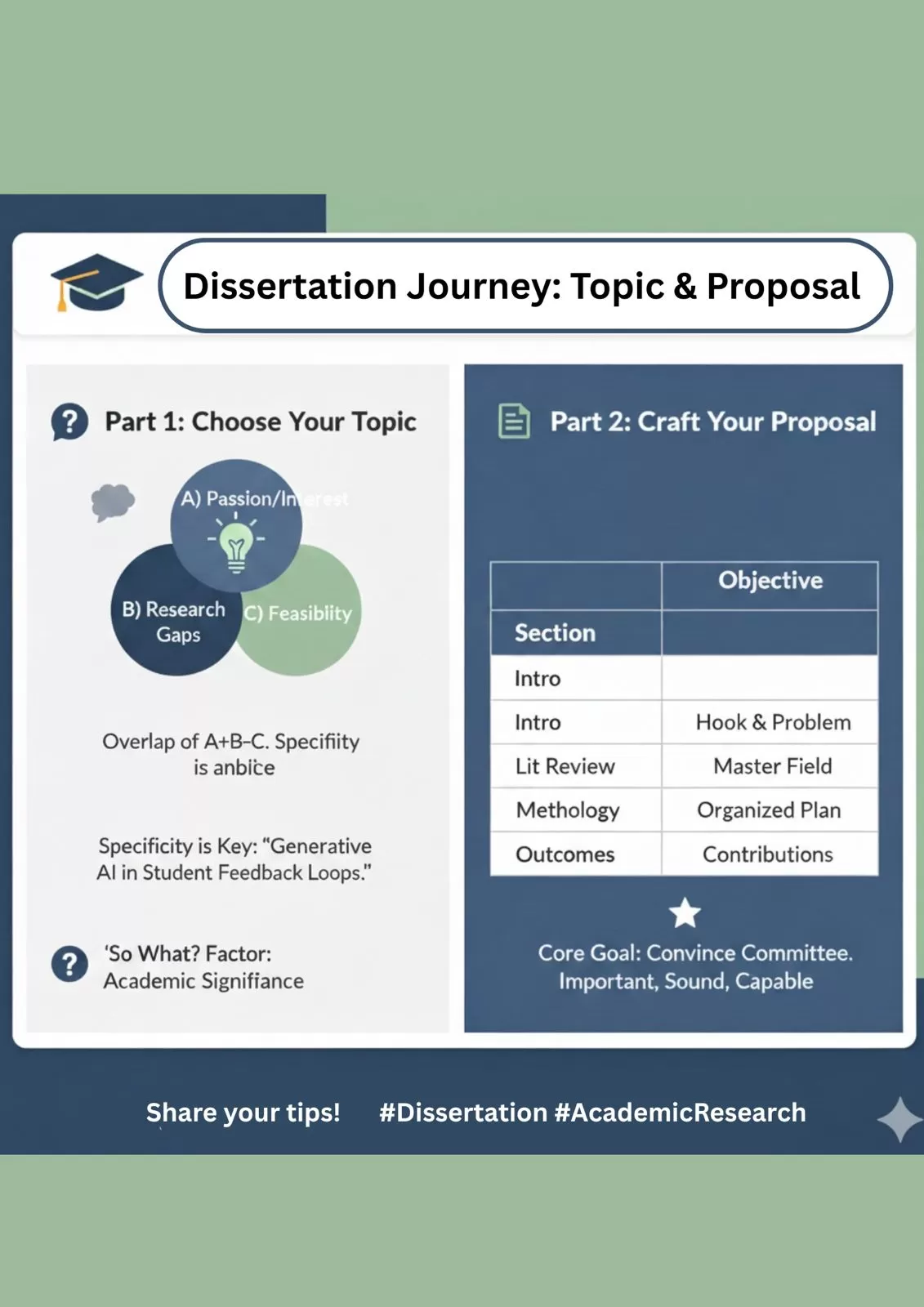
1. Identify Your Intersection: Find the overlap between (A) Your Passion/Interest, (B) Existing Literature/Research Gaps, and (C) Practical Feasibility (access to data, time, resources).
-
Tip: List 3-5 sub-fields you enjoy, then skim the most recent papers in those fields. Look for phrases like "Future research should..." or "This study did not address..."
-
-
2. Establish Scope: A common mistake is choosing a topic that's too broad. Instead of "The Impact of AI," focus on "The Impact of $\text{Generative AI}$ on $\text{Student Feedback Loop Efficiency}$ in $\text{Undergraduate History Programs}$." Specificity is key.
-
3. Test the "So What?" Factor: Your topic must have academic significance. Ask yourself: "How will my research contribute something new, even if small, to the existing body of knowledge?"
-
📝 Part 2: How to Structure a Powerful Proposal
The proposal is your research blueprint—it proves you know what you will do, why you will do it, and how you will achieve it.
-
Section Key Objective What to Include Introduction Hook the reader & state the problem. Problem Statement, Background, Research Questions/Hypotheses. Literature Review Demonstrate mastery of the field. Summarize key theories, identify the research gap your study fills. Methodology Prove your study is viable. Research Design (e.g., quantitative, qualitative), Participants/Data Source, Data Collection Tools, Data Analysis Plan. Timeline & Resources Show you're organized. Phased plan, required resources, ethical considerations. Expected Outcomes Reiterate the "So What?" Potential contributions to theory, practice, or policy. ⭐ The Proposal's Core Goal: Convince your committee that your research question is important, your methodology is sound, and you are capable of executing the work.